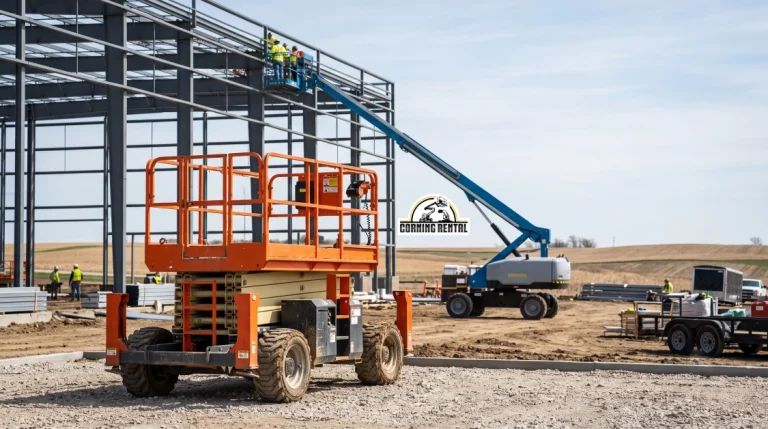
Choosing the right elevated work platform comes down to three factors: working height, horizontal reach, and the ground conditions of your job site. Picking the wrong machine costs you real money, whether that is lost time repositioning an undersized platform or blowing your rental budget on a massive machine you do not need. Contractors, utility crews, and facility managers across Iowa face this decision every day on commercial builds, agricultural facilities, and maintenance outages.
Securing the proper aerial lift requires matching your exact task requirements with the mechanical capabilities of each machine type. This guide walks through the specific performance profiles of scissor lifts, articulated boom lifts, telescopic boom lifts, and towable units so you can rent the right machine the first time.
What Is the Core Difference Between Boom Lifts and Scissor Lifts?
The main difference between boom lifts and scissor lifts is their directional movement: scissor lifts move strictly vertically, while boom lifts provide both vertical elevation and horizontal outreach.
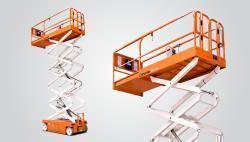
Scissor lifts rely on linked, folding pantograph supports that extend upward when hydraulic or electric cylinders engage. Because the platform sits directly above the wheel base, these units offer high lifting capacities and broad deck space. They are built to raise multiple crew members, heavy toolboxes, conduit, and ductwork straight up to a ceiling or wall.
Boom lifts utilize an extendable hydraulic arm mounted to a 360-degree rotating turntable. This configuration allows operators to position the basket up, out, and over physical obstacles like structural steel, piping, landscaping, or adjacent machinery. If your work requires navigating structural obstacles or reaching across unfinished trenches, a boom lift is essential.
When Should You Rent a Scissor Lift?
You should rent a scissor lift when your project requires working strictly overhead on flat, level surfaces with high weight capacity needs. Scissor lifts give tradesmen a stable, wide staging platform that acts as elevated scaffolding without the time-consuming teardown.
| Machine Model | Platform Height | Working Height | Ideal Job Application |
| 19′ Electric Scissor Lift | 19 ft | 25 ft | Tight indoor MEP, fit-outs |
| 26′ Electric Scissor Lift | 26 ft | 32 ft | Electrical, lighting, racking |
| 32″ Electric Scissor Lift | 19 ft to 26 ft | 25 ft to 32 ft | Narrow warehouse aisles |
| Small Platform Rough Terrain Scissor Lift | 26 ft to 33 ft | 32 ft to 39 ft | Exterior framing, siding |
| Large Platform Rough Terrain Scissor Lift | 40 ft to 53 ft | 46 ft to 59 ft | Commercial cladding, glazing |
The category divides into two operational types depending on ground conditions and site environments.
Electric Scissor Lifts for Indoor Facilities
Indoor utility, lighting, drywall, and industrial maintenance jobs require zero emissions and floor protection. Renting an electric scissor lift delivers smooth proportional controls and non-marking solid rubber tires that protect finished concrete and epoxy flooring.
A 19′ electric scissor lift fits through standard commercial doorways and operates inside freight elevators, making it a staple for multistory tenant fit-outs. When you need extra reach inside warehouses or logistics centers, a 26′ electric scissor lift provides overhead access to roof purlins and mechanical systems. For tight storage facilities with high pallet racking, a 32″ narrow electric scissor lift gives you the slim chassis required to maneuver through narrow access aisles without striking inventory.
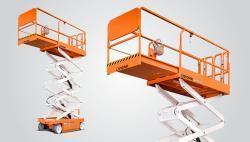
Electric Scissor Lift Rentals
Rough Terrain Scissor Lifts for Unimproved Job Sites
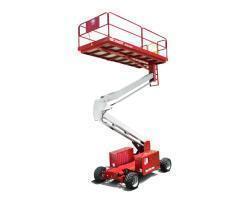
Outdoor building envelopes, commercial framing, and exterior wall installations require machines built for rough grade. A rough terrain scissor lift features four-wheel drive, heavy-lug pneumatic or foam-filled tires, oscillating axles, and automatic leveling outriggers.
A small platform rough terrain scissor lift navigates tight outdoor sites while handling sloped grade transitions around commercial pads. For high-volume exterior projects, large platform rough terrain scissor lifts provide broad workspaces and platform capacities exceeding 1,000 pounds. These allow crews to elevate heavy materials, such as exterior glass units, metal wall panels, and commercial insulation bundles, directly to the work face.
Rough Terrain Scissor Lift Rentals

When Is an Articulated Boom Lift the Right Choice?
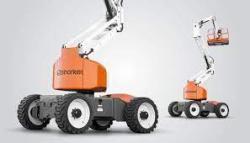
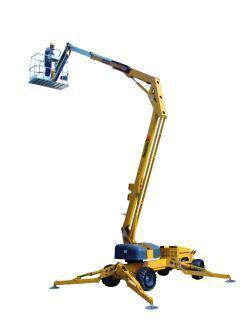
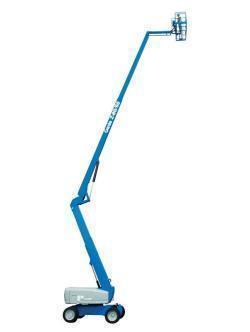
An articulated boom lift is the right choice when you must navigate up, over, and around physical obstructions to access elevated work areas. Often referred to as a knuckle boom, this machine features two or more hinged boom sections that bend independently, allowing you to position the basket over equipment, roof parapets, or interior mezzanines.
An articulated boom lift is engineered for complex geometry:
- Compact Articulated Models (40′ and 60′): A 40′ articulated boom lift provides versatile reach for HVAC installations, piping, and building repairs where space is constrained. Moving up to a 60′ articulated boom lift offers extensive horizontal outreach combined with exceptional up-and-over clearance, making it a reliable machine for industrial plant shutdowns and steel erection.
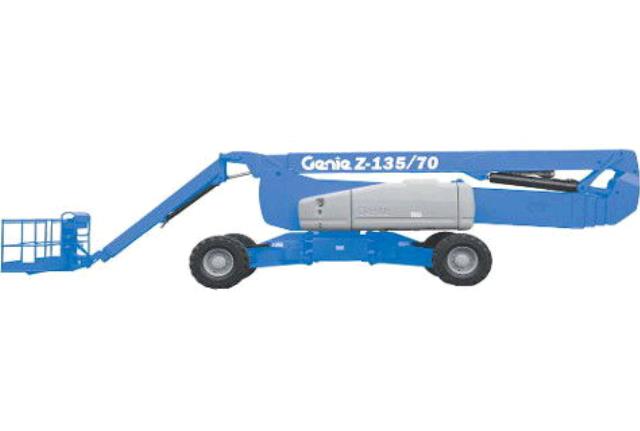
- High-Reach Articulated Models (80′ and 135′): When commercial structures feature deep roof overhangs or complex architectural setbacks, an 80′ articulated boom lift provides the reach needed to clear perimeter framing. For power plants, industrial refineries, and bridge repairs, a 135′ articulated boom lift delivers over 60 feet of horizontal outreach at extreme elevations.
- Indoor and Specialty Manlifts: Working inside finished facilities requires quiet operation. An electric boom lift eliminates exhaust fumes entirely while delivering knuckle-boom flexibility inside convention centers, aircraft hangars, and manufacturing facilities. Where ground-pressure limits apply, a 45′ lightweight self-propelled manlift gives you necessary elevation without overloading structural concrete slabs or sensitive landscape grading.
Articulated Boom Lift Rentals
When Do You Need a Telescopic Boom Lift?
You need a telescopic boom lift when your project demands maximum horizontal outreach and straight-line working height. Known across the trade as a stick boom, this machine uses straight, telescoping boom sections that extend directly outward from the base, delivering the greatest stability and reach in the industry.
Straight booms excel on open job sites where you cannot set up the machine directly adjacent to the building:
- General Construction Reach (40′ and 60′): A 40′ telescopic boom lift gives you rapid positioning for single-story and two-story commercial builds, while a 60′ telescopic boom lift provides extended horizontal reach to bridge past landscaping, retention ponds, or foundation backfill.
- Heavy Commercial and High-Rise Reach (80′ and 135′): An 80′ telescopic boom lift allows structural steel crews, precast concrete contractors, and commercial painters to service high-elevation work envelopes safely. When building multi-story grain elevators, sports facilities, or high-rise exterior envelopes, a 135′ telescopic boom lift delivers access up to fourteen stories with stable platform control even in gusty wind conditions.
Contractors working on open construction sites select a telescopic boom lift because it extends and retracts faster than knuckle booms, saving valuable labor hours when working across large building facades.
Why Choose a Towable Boom Lift for Rural and Multi-Site Projects?
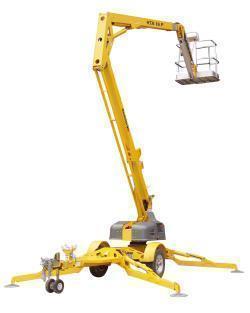
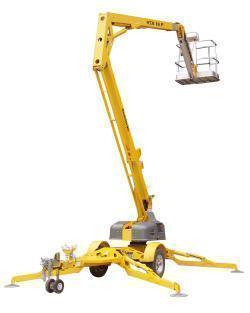
A towable boom lift is the ideal rental choice when your job requires servicing multiple sites in a single day without paying for commercial freight hauling. Towable lifts mount directly onto a trailer chassis with a standard ball hitch, electric brakes, and highway-rated lighting.
A towable boom lift is practical for regional operations:
- Tow with a Standard Work Truck: You do not need a commercial semi-tractor or flatbed trailer to transport the machine. A half-ton or three-quarter-ton pickup pulls a towable lift from site to site, keeping mobilization overhead low.
- Versatile Working Heights: A 45′ towable boom lift handles residential tree trimming, exterior painting, siding repairs, and residential roofing inspections. For elevated grain bins, regional utility poles, and pole barn construction, stepping up to a 55′ towable boom lift provides extended elevation with automatic self-leveling hydraulic outriggers that stabilize the chassis on uneven rural dirt or gravel.
Towable Boom Lift Rentals
How to Select the Right Aerial Lift for Your Job Site
Selecting the proper elevated work platform requires evaluating five critical job site parameters before finalizing your reservation. Overlooking these items leads to operational delays, failed safety inspections, and costly site mobilization re-runs.
1. Calculate Exact Working Height vs. Platform Height
Platform height is the measurement from the base of the machine to the floor of the basket. Working height adds six feet to that figure to account for an average operator’s reach. If your working height requirement is 32 feet, a 26-foot platform height machine will do the job. Renting a machine based purely on the nominal model number without calculating total reach is an expensive mistake.
2. Determine Horizontal Outreach Requirements
Vertical height is only half of the calculation. If obstacles force your machine to park 25 feet away from a wall, a 40-foot scissor lift will not help you. You must measure the linear horizontal distance from where the chassis can sit to the target work face, then check the machine’s load chart to ensure it supports the required capacity at that extension.
3. Check Platform Capacity Ratings
Every lift has an engineered weight limit that includes personnel, safety harness gear, power tools, and building supplies. Standard boom baskets accommodate between 500 and 1,000 pounds, whereas rough terrain scissor lift decks carry up to 1,500 pounds. Exceeding rated capacity trips safety overload sensors, which locks out machine movement until the excess weight is removed.
4. Evaluate Soil Stability and Ground Conditions
Indoor slab work demands non-marking electric tires and low gross vehicle weights. Rough outdoor construction sites require high ground clearance, deep-tread tires, four-wheel drive, and oscillating axles. If you are operating on uncompacted agricultural soil or sloped grades, you must select a machine with hydraulic outriggers to level the base before lifting personnel.
5. Verify Site Access and Clearance
Measure every gate, service entrance, and warehouse door along the transport path. Narrow electric scissor lifts fit through standard 36-inch doors, but large rough terrain units require broad commercial bays. Always check for overhead power lines, structural steel trusses, and fire suppression pipes before moving equipment into operating position.
Aerial Work Platform Comparison
Comparing lift categories side by side helps clarify which machine suits your operational constraints and site environments.
| Equipment Category | Vertical Reach | Horizontal Outreach | Platform Capacity | Best Ground Surface |
| Electric Scissor Lift | 19 ft to 32 ft | Vertical only | 500 to 1,000 lbs | Smooth Concrete |
| Rough Terrain Scissor Lift | 26 ft to 53 ft | Vertical only | 800 to 1,500 lbs | Uneven Dirt / Gravel |
| Articulated Boom Lift | 40 ft to 135 ft | 22 ft to 65 ft | 500 to 1,000 lbs | Slab or Firm Dirt |
| Telescopic Boom Lift | 40 ft to 135 ft | 33 ft to 80 ft | 500 to 1,000 lbs | Rough Grade / Dirt |
| Towable Boom Lift | 45 ft to 55 ft | 20 ft to 33 ft | 440 to 500 lbs | Firm Ground / Turf |
Streamlined Fleet Delivery and Job Site Support Across Iowa
Corning Rental, Sales, & Service operates South Iowa’s largest full-line construction equipment rental fleet, backed by more than 25 years of hands-on industry support. With four store locations in Corning, Shenandoah, Glenwood, and Osceola, we provide fast, reliable equipment dispatch across the region.
Our in-house fleet of semi-tractors delivers and picks up equipment within a 250-mile radius of any store location, serving jobs across South Iowa, Eastern Nebraska, and Northern Missouri, including Omaha, Council Bluffs, Des Moines, and Kansas City. Every machine is maintained and inspected by certified mechanics before leaving our facility, ensuring reliable uptime on your job site. If your crew is unfamiliar with a new machine, our delivery drivers provide on-site operational orientations so your team works safely and efficiently from day one.
Check availability, compare specifications, and book your boom lift or scissor lift online 24/7, or contact your nearest Corning Rental branch for expert equipment recommendations.
Frequently Asked Questions
What safety certifications or training do operators need to run a rented aerial lift in Iowa?
OSHA and ANSI A92 standards require all aerial lift operators to complete formal safety training, practical hands-on evaluation, and site-specific familiarization for the specific make and model rented. Employers must document certification covering equipment controls, emergency descent systems, platform capacity limits, fall protection anchorage, and overhead hazard avoidance before personnel operate equipment on site.
How do I choose between an articulated boom lift and a telescopic boom lift?
Choose an articulated boom lift if your job site features obstacles, piping, roof overhangs, or steel frames that require reaching up and over intermediate structures. Choose a telescopic boom lift when you have an open work area and need maximum straight horizontal outreach, extended working height, and rapid platform repositioning from a single ground position.
Can an electric scissor lift be used outside on a construction site?
Electric scissor lifts can only operate outside if the ground is completely flat, dry, and paved with concrete or asphalt, and if wind speeds stay within the machine’s rated outdoor limits. Most electric slab scissor lifts lack the ground clearance, tire traction, and outrigger leveling systems required to navigate unpaved dirt, mud, gravel, or sloped ground safely.
How far does Corning Rental deliver aerial work platforms?
Corning Rental provides heavy equipment delivery and pickup within a 250-mile radius from its four store locations in Corning, Shenandoah, Glenwood, and Osceola, Iowa. This delivery footprint covers job sites throughout Southern Iowa, Eastern Nebraska (including Omaha and Council Bluffs), and Northern Missouri.
What happens if an aerial lift experiences a mechanical issue on the job site?
If an aerial lift displays a mechanical fault, contact the nearest Corning Rental branch immediately. Our dedicated mobile service technicians dispatch to your job site to run diagnostic tests, repair hydraulic or electrical components, and complete on-site repairs. If the issue cannot be resolved quickly, we swap out the machine with a replacement from our rental fleet to keep your project moving forward.