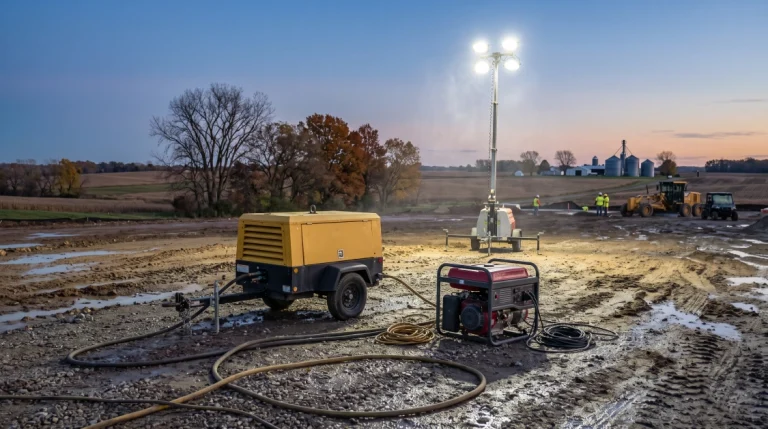
Temporary job-site utilities determine whether a remote construction project starts on schedule or sits completely idle. Utility tie-ins from regional electric co-ops often take weeks or months to reach undeveloped commercial ground, meaning general contractors, bridge builders, and road crews must supply their own electricity, compressed air, and illumination. Renting prime-power equipment allows field operations to scale electrical loads, run pneumatic tooling, and illuminate night shifts without carrying permanent capital debt or long-term storage costs.
Underestimating generator wattage trips circuit breakers continuously, while running an undersized air compressor starves pneumatic breakers, sandblasters, and post pounders of working pressure. You can review available machine configurations, check fleet availability, and schedule dispatch directly through our online equipment rental portal. Matching machine capacities to your specific tools and shift schedules ensures continuous production across every stage of the build.
What Types of Portable Power Keep Construction Projects Running Off-Grid?
The primary equipment classes that provide temporary off-grid power include portable and prime generators for electrical distribution, diesel-driven rotary screw air compressors for pneumatic power, and mobile light towers for round-the-clock site security and visibility. Each machine class handles a separate mechanical or electrical utility requirement, converting fuel directly into steady, productive energy on site.
When municipal grid power is unavailable, these machines function as the backbone of site operations:
- Towable and Portable Generators: Convert liquid fuel into regulated electrical currents, delivering single-phase or three-phase voltage to power field offices, temporary dewatering pumps, battery recharge stations, and heavy welding machinery.
- Diesel Rotary Screw Compressors: Generate steady air volume measured in cubic feet per minute, driving heavy air-driven demolition tools, dry-ice blasters, line-painting rigs, and irrigation blowout systems.
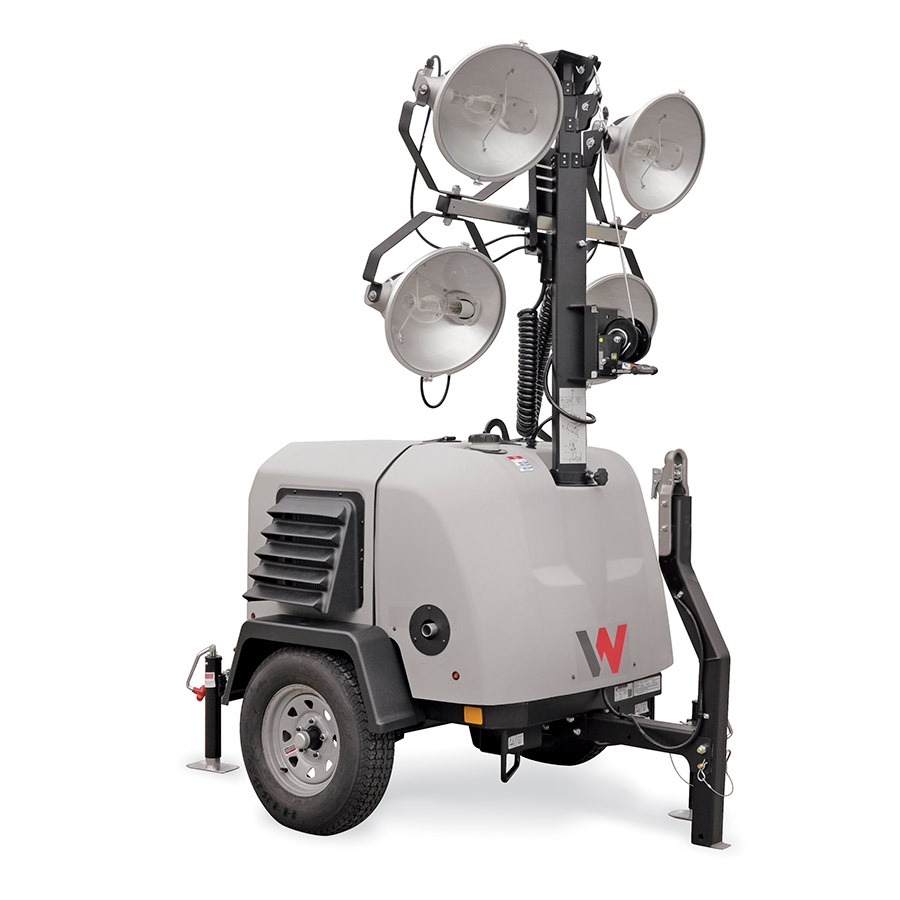
- Mobile Mast Light Towers: Use high-efficiency illumination mounted on tall telescoping masts to provide safe footing, OSHA-compliant night shift lighting, and security perimeter illumination across broad acreages.
Portable Generator Rentals
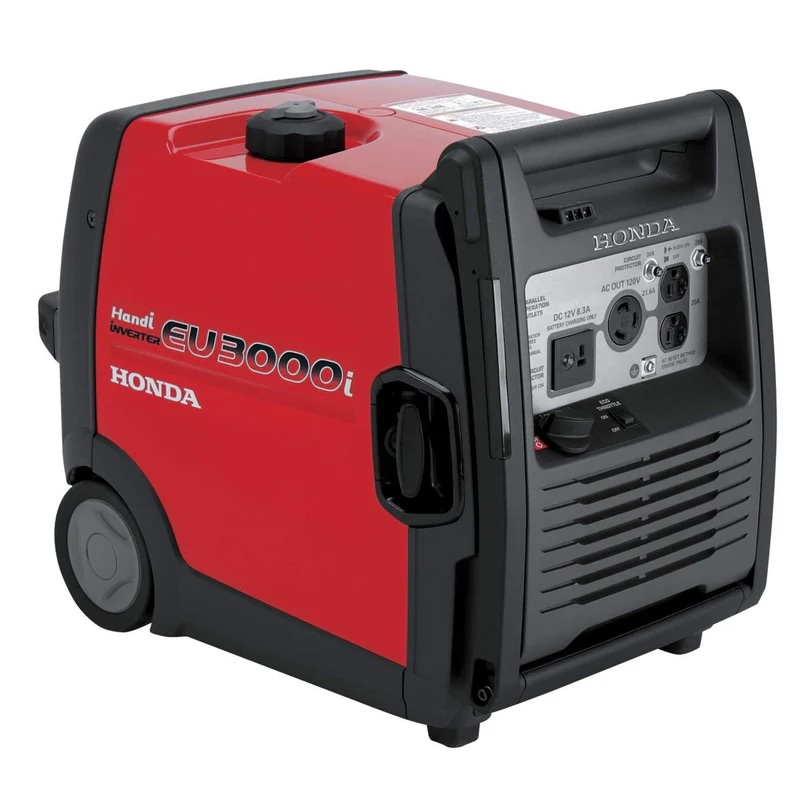
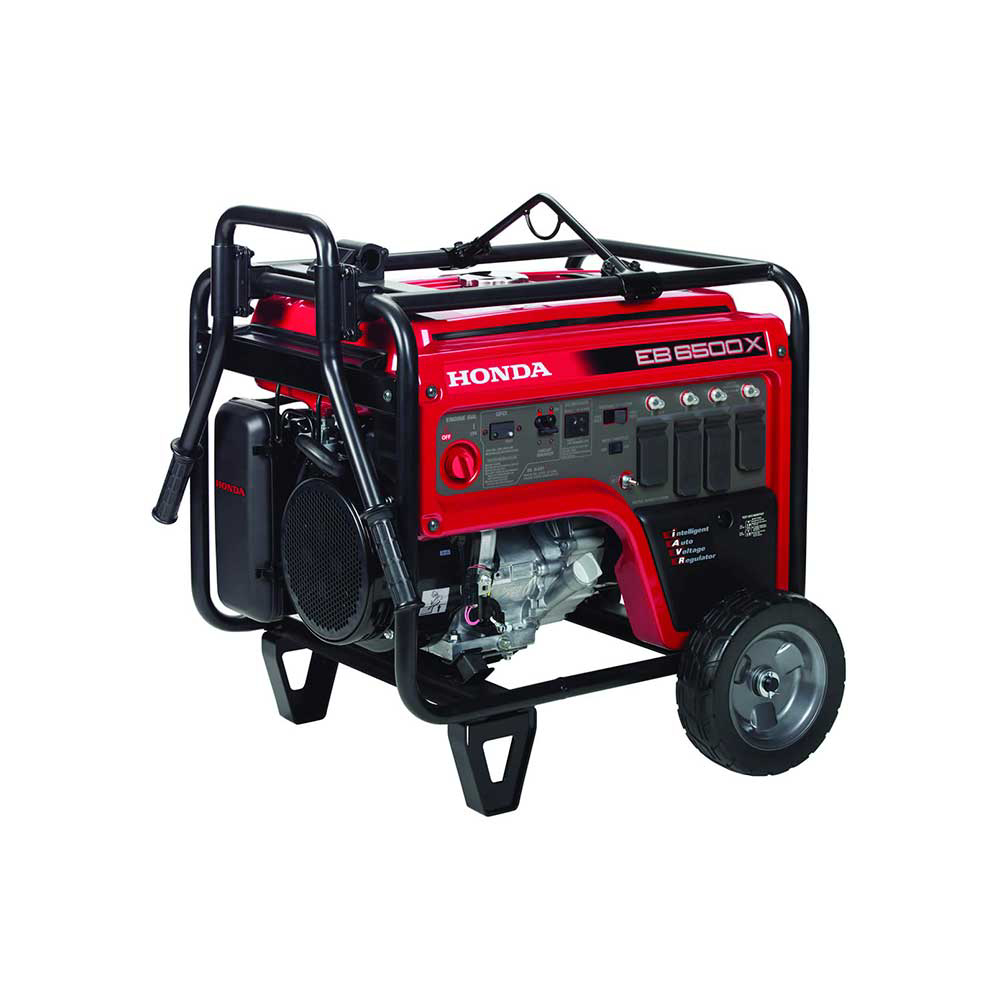
How Do You Size a Generator Rental for Job-Site Electrical Loads?
Sizing a generator rental requires calculating both running watts and starting surge watts for every piece of electrical equipment that will draw power simultaneously. Electric motors found in air compressors, submersible sump pumps, circular saws, and hydraulic power units require two to three times more wattage at initial startup than during continuous runtime.
You can browse our full line of temporary electrical gear in our generator rental selection, where capacity tiers match specific field demands:
| Generator Model | Continuous Running Watts | Peak Surge Watts | Primary Applications | Mobility Profile |
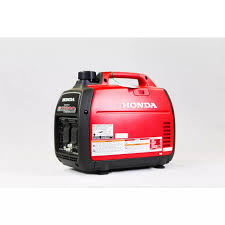
| 2,000 Watt Generator | 1,600 to 1,800 W | 2,000 W | Sensitive electronics, power tool battery charging, lighting | Hand-carry portable |
| 3,000 Watt Generator | 2,600 to 2,800 W | 3,000 W | Miter saws, commercial rotary hammers, small air compressors | Compact wheeled frame |
| 6,000 Watt Generator | 5,000 to 5,500 W | 6,000 W | Multi-tool residential framing, table saws, large sump pumps | Heavy-duty roll cage with wheels |
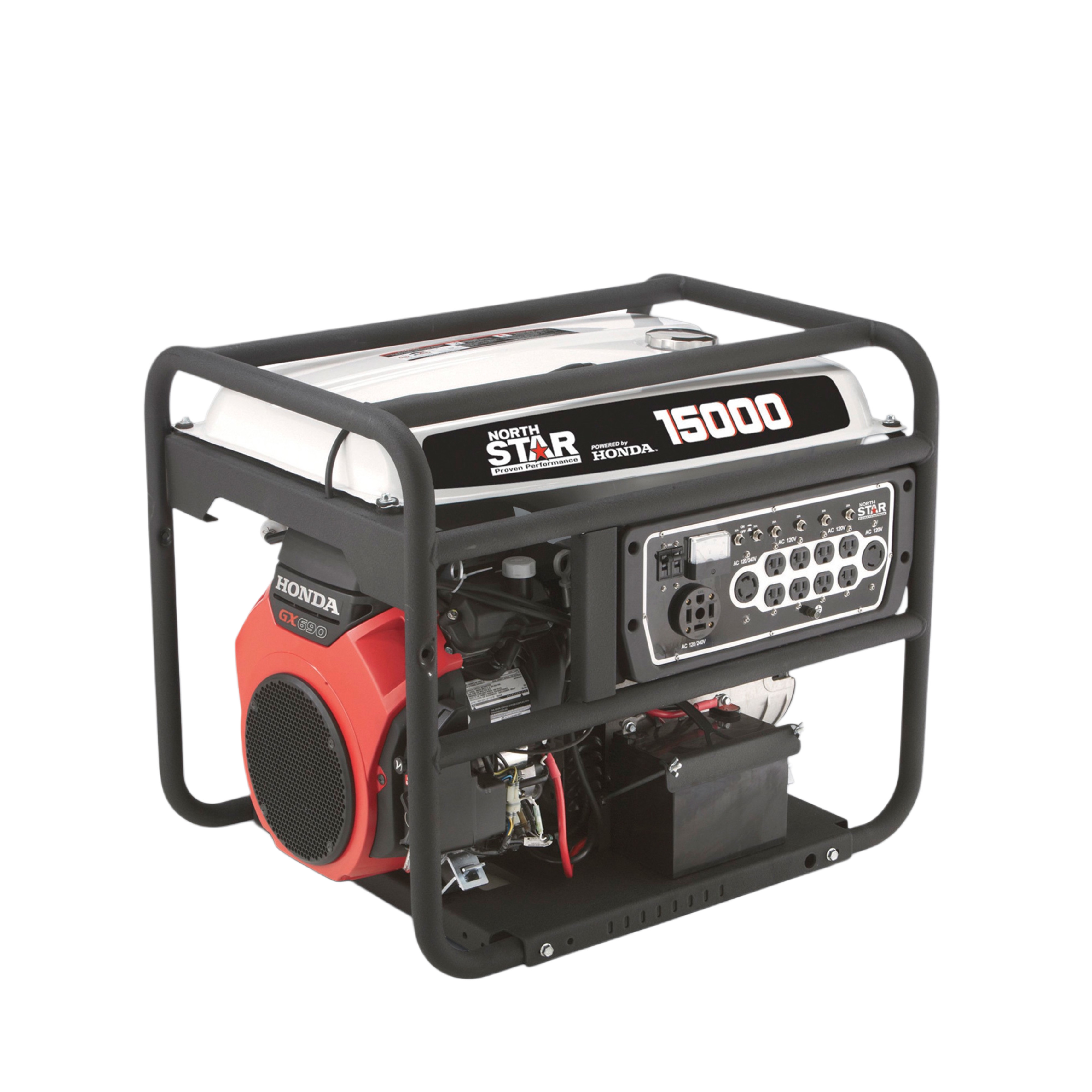
| 15,000 Watt Generator | 12,000 to 13,000 W | 15,000 W | Commercial job trailers, multiple 240V circuits, heavy welding | High-capacity wheeled frame or skid |
Portable Units (2,000 to 3,000 Watts)
A 2,000 watt generator provides clean, stable sine-wave power for testing control panels, operating surveying tools, and running job-site charging banks for cordless tool batteries. When running high-draw 15-amp power tools like commercial demo hammers, a 3,000 watt generator provides the extra headroom needed to absorb motor startup spikes without tripping internal circuits.
Mid-Range and Heavy Site Units (6,000 to 15,000 Watts)
A 6,000 watt generator handles typical framing and concrete crews, simultaneously running two 20-amp circuits for table saws, reciprocating saws, and quartz task lights. When outfitting a commercial job-site trailer complex, deep well pumps, or high-draw multi-arc welding rigs, stepping up to a 15,000 watt generator supplies clean multi-phase power through dedicated 120V and 240V locking receptacles.
When Should You Rent an Air Compressor 185 vs an Air Compressor 260?
You should choose between an Air Compressor 185 and an Air Compressor 260 based on the total cubic feet per minute required by your pneumatic tools at continuous operating pressure. Running an air tool with insufficient air volume drops line pressure instantly, which reduces impact energy on breaker tools and leads to uneven coating applications on spray equipment.
Towable Light Tower Rentals
Contractors book units through our air compressor rentals based on CFM capacity:
- Air Compressor 185 (185 CFM at 100 PSI): The 185 CFM towable compressor is the standard workhorse for general construction and utility trades. It produces ample volume to run two 90-pound jackhammers at peak impact frequency, power high-volume blow-off nozzles, or blow out seasonal irrigation lines and municipal water meters before freeze-ups.
- Air Compressor 260 (260 CFM at 100 PSI): Upgrading to a 260 CFM compressor is required when powering continuous-duty abrasive blasting pots, dry-ice blast systems, heavy rock drills, or multiple pneumatic impact wrenches on bridge deck framing. The added 75 CFM ensures air pressure remains stable even during continuous sandblasting and pipe pigging tasks.
If your owned contractor compressors suffer from intercooler blockages, fuel contamination, or oil-air separator failures, our certified mechanics provide complete diagnostic rebuilds through our service and repair department.
Why Are Mobile Light Towers Essential for Night Work and Safety?
Mobile light towers are essential for night operations because they cast broad, glare-free perimeter light over active construction zones, helping project managers maintain safe working conditions and meet strict highway closure deadlines. Department of Transportation road milling, asphalt paving, and bridge deck pours across the Midwest often take place overnight to avoid major traffic disruptions, making high-output lighting mandatory.
Adding heavy-duty light towers to your site layout offers concrete operational benefits:
- OSHA Compliance: Meets minimum illumination thresholds across pedestrian pathways, concrete wash racks, material drop-off points, and active excavator swings.
- Multi-Point Mast Articulation: Telescoping masts extend up to 30 feet into the air with 360-degree rotation, throwing illumination across multiple acres without casting deep shadows that blind ground workers.
- Extended Diesel Run Times: High-capacity onboard fuel tanks run continuously for up to 60 hours, letting night-shift crews operate through long holiday weekends without needing emergency refueling runs.
- Auxiliary Power Capabilities: Most mobile light towers feature onboard diesel generators with auxiliary convenience receptacles, giving crews a secondary power source for charging batteries and running small handheld tools directly from the chassis.
Detailed fleet operation walk-throughs and cold-weather startup procedures are published regularly on our rental guide blogs.
Jobsite Power and Air Selection Guide
Evaluating power, air output, and fuel profiles side by side ensures you rent machinery capable of meeting your exact tool requirements.
| Equipment Class | Rated Output | Primary Fuel Source | Ideal Operational Use |
| Small Portable Generator | 2,000 W to 3,000 W | Unleaded Gasoline | Cordless charging stations, survey gear, light power tools |
| Commercial Frame Generator | 6,000 W to 15,000 W | Gas or Diesel | Commercial job trailers, masonry mixers, submersible pumps |
| Rotary Screw Air Compressor | 185 CFM at 100 PSI | Diesel (Towable) | Operating dual 90 lb paving breakers, line clearing |
| High-Output Rotary Compressor | 260 CFM at 100 PSI | Diesel (Towable) | Media sandblasting, structural bridge drilling, pipe clearing |
| Mobile Telescoping Light Tower | 4-Lamp High Output | Diesel (Towable) | Highway night paving, site security, bridge maintenance |
Equipment Delivery and Contractor Logistics Across Iowa
Corning Rental, Sales, & Service stands as South Iowa’s largest full-line equipment rental facility, delivering over 25 years of proven field reliability to commercial builders and civil crews. With four store locations in Corning, Shenandoah, Glenwood, and Osceola, our teams keep rental fleets serviced and ready for fast mobilization.
Our in-house fleet of semi-tractors delivers and picks up equipment within a 250-mile radius of each location. This hauling network reaches jobs across South Iowa, Eastern Nebraska, and Northern Missouri, including Omaha, Council Bluffs, Des Moines, and Kansas City.
Every generator, compressor, and light tower undergoes complete fluid testing, load-bank verification, and filter checks before leaving our yard. On delivery, our transport drivers walk your operators through basic switchgear controls, ground-rod grounding procedures, and emergency shutoff locations so work can proceed safely.
Check machine specs, compare rental periods, and reserve your machinery online 24/7, or call your nearest Corning Rental store to discuss your site utility requirements.
Frequently Asked Questions
What happens if I connect too many tools to a job-site generator?
Connecting more electrical load than a generator’s rated capacity causes the internal circuit breaker to trip, shutting off power to protect the alternator winding from burning out. If the unit lacks modern overload safeguards, continuous overloading can cause severe voltage drops, which can burn out electric tool motors and damage sensitive digital battery chargers.
Can an Air Compressor 185 run more than one pneumatic jackhammer at the same time?
Yes, a 185 CFM air compressor easily powers two standard 90-pound pneumatic jackhammers at the same time. Standard 90-pound demolition hammers require approximately 75 to 85 CFM each at 90 to 100 PSI, meaning a 185 CFM machine leaves adequate air volume to maintain high impact energy on both tools.
What is the advantage of a diesel rotary screw compressor over a reciprocating piston compressor?
A diesel rotary screw compressor uses two interlocking helical rotors to deliver smooth, continuous air volume at 100% duty cycle without needing recovery pauses. Reciprocating piston compressors generate heat rapidly and must cycle on and off, making them inadequate for high-demand, continuous tasks like sandblasting or pavement breaking.
How far does Corning Rental deliver generators, compressors, and light towers?
Corning Rental provides heavy equipment hauling and job-site delivery within a 250-mile radius from its four store locations in Corning, Shenandoah, Glenwood, and Osceola, Iowa. This service radius covers project sites throughout South Iowa, Eastern Nebraska (including Omaha and Council Bluffs), and Northern Missouri.
Do mobile light towers require dedicated electrical connections to operate?
No, commercial mobile light towers are self-contained units equipped with an onboard diesel engine and integrated generator. They operate completely off-grid, requiring only diesel fuel to power the illumination mast and onboard auxiliary electrical outlets for days of continuous runtime.