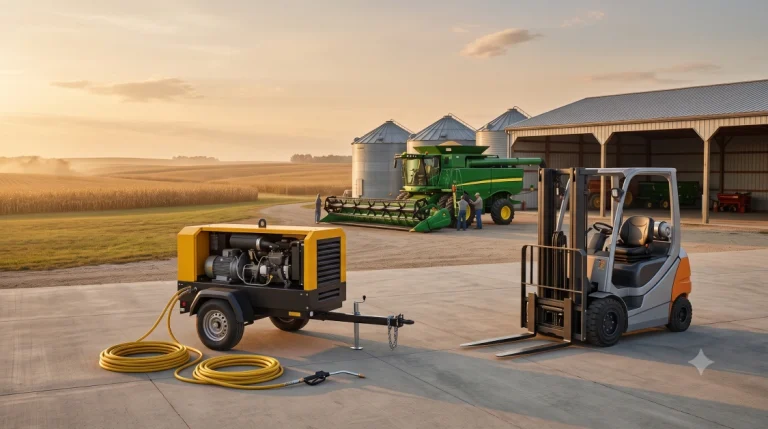
Peak harvest season across the Midwest demands intense mechanical output, strict fire prevention, and rapid material staging before winter weather closes in. When combines run sixteen hours a day through dry corn dust, grain elevators fill to capacity, and municipal irrigation systems must be evacuated ahead of the first hard freeze, working with dependable machinery keeps operations moving without capital waste.
At Corning Rental, Sales, & Service, we operate as South Iowa’s largest full line construction equipment rental facility. Backed by 25 years of field experience, our team coordinates equipment dispatch from our four physical branch yards in Corning, Shenandoah, Glenwood, and Osceola. From these locations, our dedicated transport fleet of semi-trucks, rollback beds, and equipment trailers provides direct job-site delivery and pickup within a complete 250-mile radius, serving agricultural producers, industrial plants, and commercial contractors throughout Omaha, Council Bluffs, Red Oak, Glenwood, and Northern Missouri. You can check live machinery inventory, review transparent daily or monthly rates, and reserve equipment 24/7 through our online equipment rental reservation portal.
Why Are High-Volume Towable Air Compressors Essential for Farm Equipment Harvest Blowouts?
Towable rotary screw air compressors prevent catastrophic combine fires and engine overheating by providing the sustained volume of high-pressure air needed to dislodge dry chaff, corn husk dust, and bean fuzz from hidden machine compartments.
Harvest fields generate dense clouds of airborne organic matter that settle directly onto hot exhaust manifolds, turbochargers, and alternator housings. When that buildup mixes with lingering hydraulic fluid mist, a single spark or extreme exhaust temperature can ignite the engine bay in seconds. Attempting to blow down a modern Class 8 or Class 9 combine with a small shop compressor or handheld leaf blower fails because they lack the continuous air volume to blast through packed radiator cores and internal straw chopper housings.
| Cleaning Tool / Machine | Air Volume (CFM) | Operating PSI | Farm & Harvest Application |
| Shop Compressor | 10 to 15 CFM | 90 to 125 PSI | Tire inflation and small hand tools only |
| Handheld Leaf Blower | N/A (Volume only) | 0 PSI (No static pressure) | Surface cab cleaning; cannot clear tight radiator fins |
| Towable Rotary Screw Compressor | 185 CFM | 100 to 125 PSI | Complete combine, drill, and baler daily blowouts |
| High-Pressure Pneumatic Blowpipe | 80 to 100 CFM | 100 PSI continuous | Blasting corn chaff out of cooling packages and belts |
Here is the reality of the situation during long October harvest days: stopping work to wait for a small compressor tank to rebuild pressure burns precious daylight. A commercial 185 CFM diesel rotary screw machine maintains continuous dynamic air pressure through multi-outlet hose connections, allowing two farm hands to blow down the header, feeder house, cooling package, and separator areas simultaneously in under twenty minutes. Reserving a heavy-duty diesel unit from our towable air compressor rentals provides the airflow needed to keep your harvesting fleet safe, cool, and running through harvest season.
How Does a Towable Air Compressor Prevent Commercial Irrigation Line Freeze Damage?
A towable air compressor clears underground irrigation mains, golf course sprinkler networks, and farm pivot lines by pushing high volumes of air that force out standing water before sub-surface winter freezes crack the pipe walls.
Many facility operators mistake operating pressure for air volume when winterizing water distribution networks. Applying extreme pressure from an under-sized compressor into buried PVC or polyethylene pipes can easily rupture joints and shatter valve bodies. Evacuating water safely requires continuous cubic feet per minute at moderate pressure to push a solid wall of water ahead of the air stream.
- Commercial Turf Systems: A sustained 185 CFM volume clears extensive four-inch and six-inch commercial irrigation mains without requiring high pressures that blow out sprinkler heads.
- Agricultural Pivot Systems: High CFM pneumatic air sweeps low-lying elbow spans and underground feeder lines where trapped water pools and causes expensive frost heave breaks.
- Manifold Purging: Continuous rotary screw airflow maintains volume through multi-zone manifolds, allowing groundskeepers to winterize entire athletic complexes or golf courses in a single morning.
The bottom line for your budget is that an incomplete blowout leads to cracked underground fittings that remain hidden until spring pressurization floods your grounds. Sourcing a towable diesel compressor protects your infrastructure investment and eliminates costly spring excavation repairs.
How Do You Select the Right Forklift for Warehouse and Processing Operations?
You select the right forklift by matching mast lifting height, chassis width, tire composition, and weight capacity directly to your indoor warehouse aisle clearances and flooring durability.
Agricultural chemical storage facilities, seed distribution warehouses, and industrial manufacturing plants throughout Southwest Iowa face dense material handling demands during the late summer and fall. Moving heavy pallets of seed corn, packaged fertilizer, and bagged grain requires a dependable lift truck that operates within tight racking spaces without scuffing industrial floor surfaces.
Cushion Tire Electric Forklifts for Smooth Indoor Slabs
You choose a cushion tire electric forklift when operating inside enclosed food-grade seed facilities, cold-storage units, or commercial processing plants that require zero exhaust emissions and tight turn radiuses.
Cushion tires feature smooth solid rubber molded directly to steel bands, keeping the machine profile low to the ground and offering exceptional maneuverability down narrow pallet racking aisles. The electric powertrain runs silently, produces zero toxic carbon monoxide, and eliminates combustion heat inside insulated warehouse spaces.
Pneumatic Tire Forklifts for Indoor-Outdoor Yard Transfers
You select an internal combustion forklift with pneumatic tires when your operators must transport palletized freight from smooth warehouse concrete out into paved gravel staging yards or unpaved truck docks.
Solid pneumatic tires absorb shocks from gravel transitions, dock levelers, and asphalt expansion joints without going flat. What this means for your facility throughput is that a single machine can offload flatbed trailers in the yard and carry materials directly to interior staging bays without spinning out. To evaluate load capacities and mast configurations, browse our full lineup of forklift rentals.
When Should You Choose a Rough-Terrain Telehandler Over a Standard Warehouse Forklift?
You should choose a rough-terrain telehandler over a standard warehouse forklift when your material staging requires multi-story forward outreach over muddy terrain, unpaved ag fields, or structural building perimeters.
Standard warehouse forklifts rely on straight vertical masts and small tires that sink immediately when driven off finished concrete. When offloading bulk grain bins, positioning heavy hay bales, or staging structural framing lumber on uncompacted rural ground, you require high ground clearance, four-wheel drive, and forward reach.
Telehandlers feature a rear-mounted boom assembly that extends forward and upward, allowing your operators to pick heavy payloads off the far side of a semi-trailer or place roofing trusses directly onto second-story framing lines. Pairing your lifting operations with a machine from our telehandler rentals ensures that rough outdoor ground never halts your building or distribution schedule.
What Support Equipment Prevents Seasonal Ag and Industrial Bottlenecks?
Specialized compaction rollers and high-capacity earthmoving attachments provide the ground stabilization and site access needed to stage heavy harvest machinery and secure winter building pads.
Preparing acreage ground for equipment staging yards or new pole barn pads requires high compaction density to prevent loaded semi-trailers from sinking into soft topsoil. Running an underpowered unit over backfilled utility trenches or new aggregate paths creates soft spots that buckle under heavy axle loads.
- Pavement & Subgrade Compaction: Running smooth drum rollers or trench compactors from our soil compactor rental fleet locks down crushed limestone base around grain bin staging sites.
- Site Preparation & Spoil Moving: Utilizing agile track machines from our skid steer rental lineup allows operators to backfill foundation footings and clear heavy tree lines with equal efficiency.
- Elevated Facility Maintenance: Deploying high-reach platforms from our boom lift rental inventory gives maintenance teams safe access to high grain legs, elevator conveyors, and exterior pole barn siding.
How Does a 250-Mile Delivery Radius Protect Your Operational Timelines?
Partnering with an equipment rental facility that maintains an internal transport fleet and a 250-mile delivery radius protects your schedule by guaranteeing heavy machinery arrives directly at your facility or farm gate on time.
Searching online for heavy equipment rental near me often connects you with digital broker operations that own no machinery and subcontract hauling to third-party carriers who arrive hours late. During the narrow harvest window, losing half a day waiting for an air compressor or forklift can stall an entire fleet of grain trucks and combines.
At Corning Rental, Sales, & Service, we operate our own transport fleet across our four store locations in Corning, Shenandoah, Glenwood, and Osceola. We deliver fully inspected, job-ready machinery directly to grain facilities in Red Oak, industrial parks in Council Bluffs, manufacturing plants in Omaha, and farming operations across Southwest Iowa. If an unexpected mechanical issue occurs in the field, our factory-trained mobile technicians dispatch in fully stocked service trucks to handle on-site repairs or provide an immediate machine swap so your operation never loses momentum.
Frequently Asked Questions
What size air compressor is required to blow out farm combines and grain harvesters?
A 185 CFM towable diesel rotary screw air compressor is the industry standard for daily harvest blowouts. It supplies the continuous, high-volume airflow needed to clean deep radiator cores, engine compartments, and separator housings simultaneously without pressure loss, significantly reducing combine fire risks.
Can a warehouse forklift be operated safely on packed gravel or dirt yards?
Standard cushion tire warehouse forklifts are designed strictly for smooth, solid concrete slabs and will lose traction or bottom out on unpaved ground. To operate safely on packed gravel or dirt, you must use a pneumatic tire forklift or step up to a four-wheel-drive rough-terrain telehandler.
What is the advantage of using high CFM over high PSI for commercial irrigation winterization?
High CFM volume purges water out of underground lines effectively at safe, moderate operating pressures between 50 and 80 PSI. Relying on low CFM with excessive PSI can shatter brittle PVC fittings, damage backflow valves, and still leave pooled water behind that freezes and splits pipe walls during winter.
What delivery options are available for industrial and agricultural machinery rentals?
We provide direct facility and farm gate delivery within a 250-mile radius from our four store branches in Corning, Shenandoah, Glenwood, and Osceola. Our dedicated heavy-haul fleet handles prompt delivery and pickup across Southwest Iowa, Eastern Nebraska, and Northern Missouri.
What documentation is required to rent a forklift or towable compressor from Corning Rental?
Renting equipment requires a valid government-issued driver’s license, an active commercial account or major credit card, and appropriate insurance coverage. Commercial contractors provide a standard Certificate of Insurance (COI), while agricultural operators and independent businesses can select our Loss Damage Waiver (LDW) at checkout.