Getting up to an elevated work area safely without chewing through payroll comes down to picking the right machine footprint before your crew ever pulls up to the job site. If you have ever watched a paint crew lose half their morning fighting extension ladders around a porch roof, or had a contractor call in because their lift sank to the axles in backyard clay, you know that aerial access is never just about vertical height.
At Corning Rental, Sales, & Service, we operate as South Iowa’s largest full line construction equipment rental facility. Over the last 25 years, we have built out four branch yards across Corning, Shenandoah, Glenwood, and Osceola to make sure contractors and property owners across Iowa, Eastern Nebraska, and Northern Missouri have reliable iron when they need it. We run our own semi-trucks and tilt-beds, which means we handle delivery and pickup anywhere within a 250-mile radius from our doors. You can check live equipment availability, look over clear daily or monthly rates, and lock in your machine anytime using our online equipment rental reservation portal.
What Types of Boom Lifts Should You Rent for Elevated Projects?
You should rent either an articulating boom, a straight telescopic stick boom, a towable bucket lift, or an electric slab lift depending on whether you need to reach over obstacles, reach straight out across open dirt, or tow the unit behind your own truck.
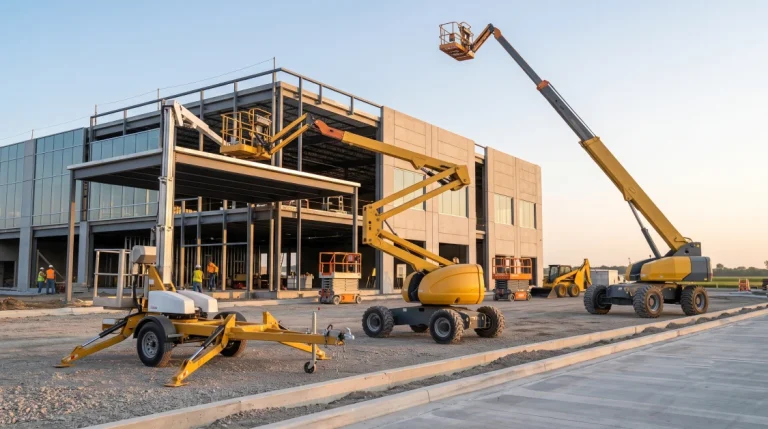
Every style of aerial work platform is engineered around a specific kind of site access. Trying to make the wrong machine work on your site usually results in scarred turf, dented gutters, or a machine that locks its controls because the slope sensors trip. Browsing our full lineup of aerial lift equipment rentals lets you look at working footprints and pick a machine that fits your actual site conditions.
- Articulating Knuckle Booms: Multiple hinge points let you go up, over, and around rooflines, parapets, and structural steel to get right against the work surface.
- Telescopic Straight Booms: Straight extension gives you maximum horizontal reach across foundation trenches and open mud where you cannot get the base close to the building.
- Towable Trailer Booms: Lightweight frames with hydraulic outriggers that hitch straight to your standard pickup truck so you avoid heavy delivery fees on residential jobs.
- Electric Slab Booms: Compact chassis with non-marking tires built for quiet, fume-free mechanical and electrical work on flat warehouse concrete.
When Is an Articulating Boom Lift the Best Choice for Exterior Painting and Siding?
An articulating boom lift is the best choice when you need to navigate around chimneys, porch overhangs, gutters, or mature landscaping to place painters right where they need to be.
Very few exterior painting jobs offer a straight shot up the side of a wall. You usually have a wraparound porch, a garage roof, or decorative trees standing directly between the driveway and the peak of the house. Knuckle booms let you elevate the main riser tower and then articulate the jib arm over the obstacle, giving painters a stable platform to spray siding, prep soffits, and caulk trim without resting heavy ladders against fresh paint.
Here is the reality of the situation for anyone pricing a commercial paint contract: moving step ladders or resetting scaffolding eats up a huge percentage of your daily labor hours. Sourcing a machine from our articulated boom lift rentals gives your operators smooth proportional basket controls and working heights from 40 feet to over 135 feet. That means your crew spends their shift with paint on the wall instead of climbing up and down staging.
Why Do Commercial Builders Rely on Telescopic Boom Lifts for High-Reach Construction?
Commercial builders rely on telescopic boom lifts because straight stick booms provide maximum horizontal reach and a rock-solid basket platform at extreme working heights.
When you are setting steel beams, hanging commercial exterior panels, or installing second-story glass curtain walls, boom sway in an articulated knuckle can make precision work nerve-racking for your crew. Telescoping booms extend linearly from a heavy counterweighted base, giving your operators the rigid platform they need when working out past the 50-foot mark.
The bottom line for your budget is that under-sizing your reach forces you to keep repositioning the machine all day, tearing up the grade and burning through diesel. Reserving a machine from our telescopic boom lift rentals gives you four-wheel drive, excellent ground clearance, and platform heights up to 135 feet. That allows your operators to stage once on solid ground and work clean across open foundation footings or rough exterior terrain.
When Should You Rent a Towable Boom Lift Instead of a Self-Propelled Machine?
You should rent a towable boom lift when you are working on finished residential lawns that cannot handle heavy machinery weight or when you want to transport the equipment yourself.
A self-propelled 45-foot boom lift easily weighs between 12,000 and 15,000 pounds. Driving that kind of steel across a homeowner’s sod, over a septic field, or across decorative paver walkways will leave deep ruts that cost hundreds of dollars to repair. Towable bucket lifts weigh closer to 3,500 to 4,500 pounds, rolling on balanced trailer axles that hook to a standard two-inch ball on your work truck.
Once you back the trailer into place, hydraulic outriggers level the chassis even on mild slopes or uneven turf. Checking our towable boom lift inventory gives independent painters, tree trimmers, and remodelers 35 to 50 feet of elevated reach without the logistical overhead of scheduling semi-truck freight.
How Do Electric Boom Lifts and Scissor Lifts Compare for Indoor and Outdoor Work?
Electric boom lifts give you up-and-over outreach around interior obstacles, while electric scissor lifts provide straight vertical lifting capacity on flat concrete slabs.
If your crew is retrofitting lighting, running conduit, or servicing HVAC systems inside an active distribution center or church sanctuary, gas or diesel exhaust is out of the question. An electric boom lift rental lets your technicians reach over high-bay pallet racking and stationary machinery from tight warehouse aisles without marking up clean epoxy floors.
When your work involves lifting two or three technicians along with bundles of pipe, ductwork, or sheetrock straight up to the ceiling, our scissor lift rentals are the smarter call. Scissor decks give you wide platform space and serious payload capacity. If your job is outdoors on unpaved dirt, switching to a rough-terrain scissor lift with four-wheel drive and leveling jacks gives your siding and glazing crews that same large work deck on uneven ground.
What Key Factors Determine Boom Lift Rental Costs and Machine Sizing?
Boom lift rental rates come down to machine working height, boom type, engine configuration, and the total duration of your rental agreement.
Planning out your schedule ahead of time will save you substantial money compared to calling in an emergency one-day rental when you get stuck. Daily rates work well for quick paint touch-ups or storm damage inspections, but weekly and monthly rental rates cut your daily operating cost down dramatically.
- Working Height vs Horizontal Outreach: Looking only at platform height without checking the horizontal reach envelope can leave your crew stranded several feet short of an exterior work zone.
- Machine Weight and Hauling: Heavy 60-foot to 135-foot stick booms require commercial semi-trucks and transport permits, while towable lifts ride behind your own pickup.
- Power Source Selection: Electric models save money on indoor warehouse projects, while rugged diesel engines deliver the continuous torque required to climb muddy job-site grades.
- Damage Waiver Protection: Adding an optional damage waiver protects your bottom line against accidental job-site scrapes, falling debris, or tire damage.
To compare specs, outreach charts, and upfront pricing for your next project, look over our complete boom lift rentals catalog.
How Does a 250-Mile Delivery Radius Protect Your Project Timelines?
Working with an equipment provider that runs its own delivery fleet within a 250-mile radius protects your schedule by guaranteeing the machine shows up on your job site when promised.
Searching online for equipment often points you toward national broker sites that own no iron and hire random third-party hotshot haulers who show up half a day late. When your aerial lift does not show up on time, your crews sit around the truck burning through your margins.
At Corning Rental, Sales, & Service, we manage our own transport trucks and trailers out of our yards in Corning, Shenandoah, Glenwood, and Osceola. We deliver clean, serviced machinery directly to commercial sites in Des Moines and Omaha, industrial plants along the Missouri River, and residential projects throughout Southwest Iowa. If a machine ever has an issue in the field, our service mechanics roll out in fully stocked service trucks to fix it on site or swap the machine out so your job keeps moving.
Frequently Asked Questions
What is the practical difference between an articulating boom and a telescopic boom?
An articulating boom has hinged knuckle joints that let the arm bend up and over roof edges, parapets, and structural obstacles. A telescopic boom extends in a single straight line, giving you maximum horizontal outreach and a stiffer platform at higher elevations on open sites.
Can I tow a trailer-mounted boom lift with a standard half-ton pickup?
Most towable boom lifts weigh between 3,000 and 5,000 pounds and use a standard two-inch ball coupler. A properly equipped half-ton or three-quarter-ton truck with an appropriate hitch rating and trailer brake hookup can easily tow them down the highway.
Do I have to wear a safety harness in a boom lift?
OSHA regulations require anyone working from an aerial boom lift to wear a full-body harness connected to the designated platform anchor point with an energy-absorbing lanyard.
How far does Corning Rental deliver aerial machinery?
We deliver heavy equipment within a 250-mile radius from our four store locations in Corning, Shenandoah, Glenwood, and Osceola. That footprint covers job sites across Southwest Iowa, Eastern Nebraska, and Northern Missouri, including Omaha, Des Moines, Council Bluffs, and Lincoln.
What happens if an aerial lift breaks down on my job site?
If a rental machine malfunctions, call our dispatch team right away. We send out a mobile service technician in a fully stocked service truck to repair the machine on site or swap it out with another unit from our fleet to keep your crew working.